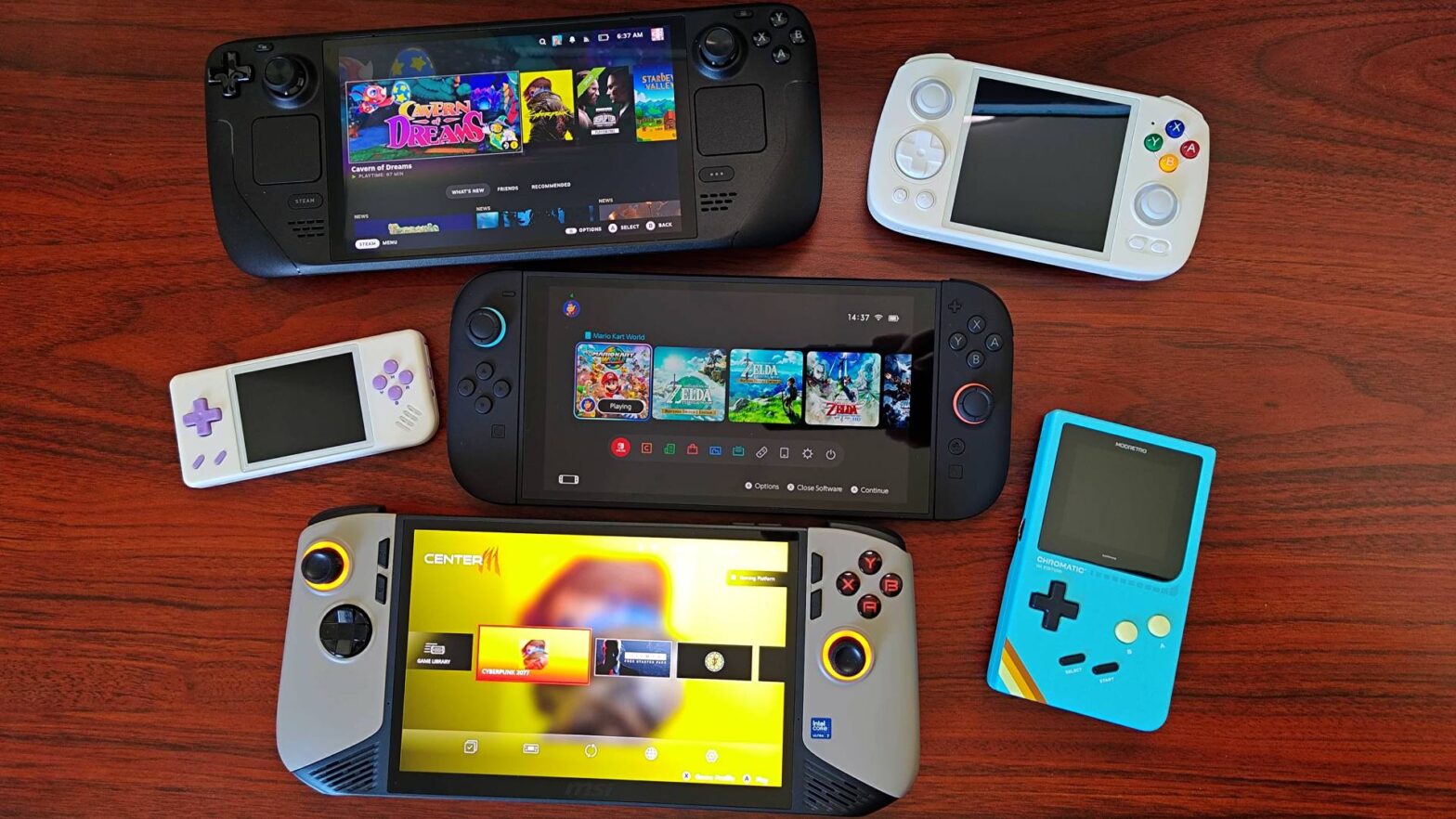
When Valve launched the Steam Deck in February 2022, it proved something the gaming industry had long doubted: handheld PC gaming had mainstream appeal. Previous attempts—from the GP2X to the GPD Win—had remained niche curiosities. The Steam Deck demonstrated that gamers would embrace a device that let them play their existing PC libraries anywhere, without compromises. Three years later, the handheld category has exploded into one of gaming’s most dynamic segments, and at GDC 2026, Microsoft announced features designed specifically for this growing category, beginning with Auto Super Resolution rolling out to ASUS ROG Ally devices in April.
The Handheld Gaming Revolution and Auto SR

Auto Super Resolution represents a philosophical shift in how Microsoft thinks about gaming performance. Traditional upscaling technologies like DLSS, FSR, and XeSS require developer implementation—they’re tools that game creators must integrate, optimize, and test. Auto SR operates differently. It works automatically, analyzing frame data in real-time and applying intelligent upscaling without requiring any game-specific code. For handheld devices with limited thermal budgets and battery capacity, this intelligence matters enormously.
The technical challenge of handheld PC gaming is straightforward but brutal: these devices must run the same games as desktop systems with powerful graphics cards, but within power envelopes of 15-30 watts rather than 200-500 watts. Every watt counts, every degree of heat matters, and every frame must be rendered efficiently. Traditional approaches force tradeoffs: lower resolutions, reduced settings, capped frame rates. Auto SR changes this equation by intelligently allocating rendering resources where they matter most.
When a game is GPU-bound—meaning the graphics processor is the limiting factor—Auto SR can reduce internal rendering resolution while using neural networks to reconstruct high-quality output, effectively trading computational load for visual fidelity. When a game is CPU-bound—meaning the processor is struggling to keep up—Auto SR can optimize frame scheduling and resource allocation to smooth performance. The system learns from gameplay patterns, adapting its behavior to each title’s unique characteristics.
For players, the benefits are tangible. Games that would otherwise stutter or drain batteries within an hour run smoothly, extending both playtime and enjoyment. Titles that required medium settings on the go can push to high or ultra. Battery life improves by 20-30% in many scenarios because the GPU isn’t working as hard. The device becomes more capable, more versatile, and more enjoyable to use.
Microsoft’s investment in handheld gaming extends beyond Auto SR. Xbox Game Pass integration ensures that handheld owners have instant access to hundreds of titles. Cloud saves enable seamless transitions between devices. Xbox Play Anywhere titles require only a single purchase for both PC and Xbox versions. The company is building an ecosystem where handhelds are first-class citizens rather afterthoughts.
The hardware landscape has diversified dramatically since the Steam Deck’s debut. ASUS ROG Ally targets performance enthusiasts with its 120Hz display and 30W mode. Lenovo Legion Go experiments with detachable controllers and a built-in kickstand. MSI Claw brings Intel Arc graphics into the category. Ayaneo and GPD continue pushing bleeding-edge specifications. Each device makes different tradeoffs: screen quality versus battery life, weight versus performance, price versus features. What unites them is the expectation that PC games should be playable anywhere—on trains, in coffee shops, on couches, during flights.
This expectation carries profound implications for game design. Developers who once optimized solely for desktop experiences must now consider handheld scenarios. UI elements need scaling for smaller screens. Text must remain readable at lower resolutions. Control schemes must accommodate thumbsticks and buttons rather than keyboard and mouse. Touch interfaces become relevant. The studios that adapt thoughtfully capture an expanding audience; those that don’t frustrate players who want their games everywhere.
The technology enabling this revolution extends beyond Microsoft’s contributions. AMD’s Ryzen Z1 and Z2 series processors, designed specifically for handhelds, integrate powerful RDNA 3 graphics with efficient Zen 4 CPU cores. Intel’s new Arrow Lake chips bring improved integrated graphics to competing devices. Valve continues refining SteamOS, proving that a console-like experience is possible on PC hardware. Component suppliers are developing smaller, more efficient displays, batteries, and cooling solutions purpose-built for portable gaming.
Industry projections suggest continued expansion. The handheld PC market is expected to grow at 25% annually through 2030, reaching over 15 million units per year. Asia-Pacific leads adoption, with gamers in China, Japan, and South Korea embracing devices that combine PC library access with portable convenience. Western markets follow, driven by younger gamers who value flexibility and older gamers who appreciate the ability to play during travel or family time.
Microsoft’s strategic positioning reflects this growth potential. By building platform features rather than hardware specifications, the company ensures that its ecosystem benefits regardless of which devices succeed. Auto SR, Gaming Copilot, seamless cross-device progression, and Xbox Game Pass integration all serve the same goal: making gaming frictionless regardless of form factor. Players who invest in Microsoft’s ecosystem know their games, saves, and friends will follow them across any screen.
For the broader gaming industry, the handheld revolution represents both opportunity and challenge. Opportunity because addressable audiences expand with each new device sold. Challenge because optimization requirements multiply across form factors. The studios that embrace this complexity, building flexible engines and adaptable designs, will capture disproportionate share of a rapidly growing market. Those that cling to desktop-only thinking will watch players take their favorite games elsewhere.